
Amazon Vendor Label Placement Mistakes That Create Receiving Problems
Label placement might seem like one of the smaller details in Amazon Vendor operations, but small details are often where bigger compliance and receiving problems begin.
A label may be present, but that does not always mean it is useful. If a barcode is covered, wrinkled, duplicated, placed over a seam, or competing with another label, Amazon may not be able to scan and process the shipment efficiently.
That is where a seemingly minor warehouse issue becomes something much bigger: delayed receiving, inventory discrepancies, chargebacks, shipment investigations, and avoidable internal firefighting.
For Amazon Vendors, label placement is part of shipment quality control.
Why Label Placement Matters in Amazon Vendor Operations
Amazon fulfilment centres are built for speed, consistency, and scan accuracy. They are not designed for interpretation.
When a carton, pallet, or shipment arrives, the information needs to be clear, visible, and easy to process. If warehouse teams or automated systems are faced with duplicate barcodes, covered labels, damaged labels, or conflicting identifiers, the receiving process becomes slower and more vulnerable to error.
This matters because Amazon Vendor shipment compliance does not only depend on whether the right information exists somewhere on the box. It depends on whether that information can be used quickly and accurately at the point of receiving.
In high-volume environments, one poor label placement decision can be repeated across hundreds of units. What starts as a small operational inconsistency can quickly become a wider receiving issue.
Common Amazon Vendor Label Placement Mistakes
Most label placement problems are not caused by carelessness. They usually happen because warehouses are busy, processes are split across teams, and shipments are being prepared under pressure.
The most common Amazon Vendor label placement mistakes include:
- Labels placed over carton seams
- Carrier labels covering Amazon labels
- Old labels left visible on reused cartons
- Wrinkled, damaged, or poorly printed labels
- Duplicate barcodes or conflicting shipment references
- Barcode hierarchy mismatches between units, inner packs, and case packs
- Labels placed too close to carton edges
- Labels applied to unstable or curved surfaces
- Labels inside reflective plastic pouches
- Pallet labels hidden beneath stretch wrap
Each issue may seem minor in isolation, but every one of them can create scanning problems once the shipment reaches Amazon's fulfilment network.
Labels Placed Over Carton Seams
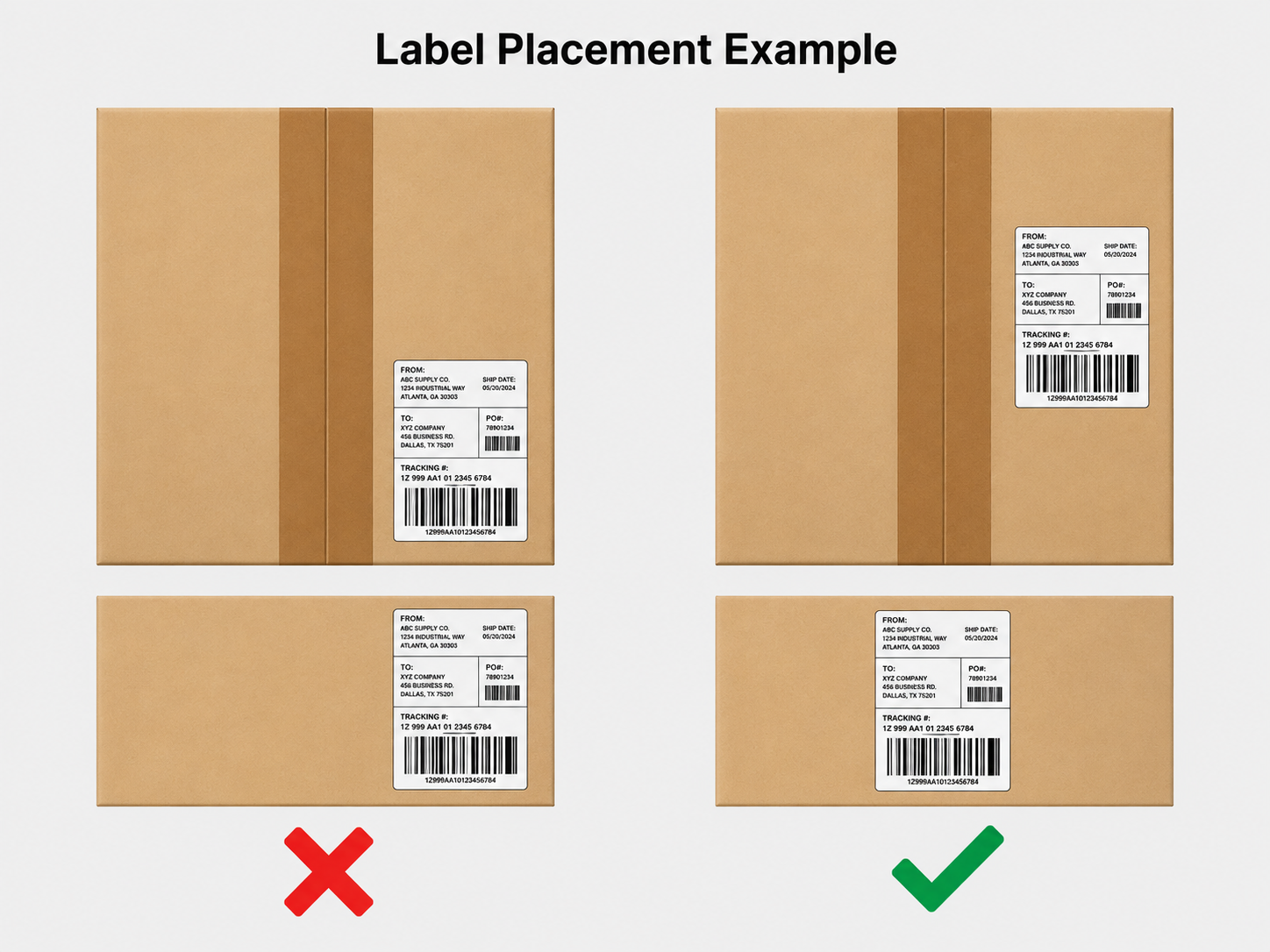
One of the most common label placement errors is applying a barcode across a carton seam, edge, or fold.
The label may look readable when it leaves the warehouse, but cartons move, bend, compress, and shift during handling and transport. A barcode placed across a seam can distort, split, or become unreadable by the time it reaches Amazon.
Amazon specifically recommends placing labels in the middle of the carton panel rather than over seams, folds, corners, or edges. SSCC labels should not be placed on the top of cartons and should remain at least 5 cm from carton edges wherever possible.
The safer approach is to apply labels to a flat, stable surface where the barcode remains visible and scannable throughout the shipment journey.
Carrier Labels Covering Amazon Labels
Carrier alignment is another major part of Amazon Vendor compliance.
A shipment may leave the warehouse with the correct Amazon labels applied, only for a carrier label to be added later in a position that covers or partially blocks the Amazon barcode. This creates confusion at receiving because the most important identifier may no longer be visible or easy to scan.
Warning labels can create the same problem. While they may be required for handling purposes, they should never obscure carton or pallet labels.
This is why Amazon Vendor teams need clear alignment with carriers and third-party logistics partners. Everyone involved in the shipment flow needs to understand which labels must remain visible and which areas of the carton or pallet should be avoided.
Old Labels Left Visible
Reused cartons can create problems when old labels, obsolete barcodes, or previous shipment references are left visible.
This is especially risky when old labels are still scannable. Amazon fulfilment centre teams and systems need clear information, not a choice between several possible identifiers.
Before dispatch, teams should remove or fully cover any outdated labels so the carton only presents current, relevant shipment information.
Wrinkled, Damaged, or Poorly Printed Labels
A barcode does not need to be completely destroyed to create problems. Slight distortion, poor print quality, moisture damage, or uneven application can all make a label harder to scan.
This is particularly important where labels are applied quickly, printed in batches, or attached to dusty, damp, or unstable packaging surfaces.
Many labelling issues originate with print quality. Amazon specifically advises against using inkjet printers because labels are more susceptible to smearing and blurry barcodes. Dirty printer heads are also a common cause of scan failures.
Labels printed using coloured ink can reduce scan accuracy, while metallic labels should be avoided entirely.
A simple pre-dispatch visual check can help catch these issues before they become Amazon receiving problems.
Packaging Can Affect Label Scanning Too
Even correctly printed labels can become difficult to scan if they are packaged incorrectly.
Amazon specifically advises against placing carton labels inside transparent plastic pouches because reflections can interfere with barcode scanning.
Labels should remain flat, visible, and easy to scan throughout transport, handling, and receiving.
Barcode Hierarchy Mistakes Create Receiving Problems
Not all barcode issues are placement issues.
Sometimes the barcode is perfectly visible, but it represents the wrong level of packaging.
For example:
- A case pack may display the barcode for the individual unit inside.
- An individual unit may display the barcode intended for the outer case pack.
- A master carton may share the same barcode as the products it contains.
These mistakes can create receiving accuracy issues because Amazon's systems may interpret the shipment at the wrong packaging level.
A case pack intended to contain six units may be received as a single unit. Likewise, a single unit may be interpreted as an outer pack quantity.
The result can include:
- Inventory discrepancies
- Shortages
- Receiving delays
- Payment inaccuracies
- Additional investigations
Amazon requires each packaging level to accurately reflect its contents. Where duplicate barcodes exist across packaging hierarchies, inappropriate barcodes should be covered to prevent scanning errors.
This is another example of how a seemingly small labelling decision can create much larger receiving issues downstream. We explore the wider receiving process in our Ultimate Guide to Amazon Receiving Accuracy and Receive Process Compliance.
Overlabelling Creates Operational Confusion
Overlabelling deserves its own attention because it often comes from good intentions.
Teams add extra labels because they want to reduce risk, improve visibility, or make the shipment easier to identify. The problem is that more labels do not always create more clarity.
In Amazon Vendor operations, overlabelling can create:
- Duplicate barcode references
- Conflicting shipment identifiers
- Scan confusion
- Routing delays
- Additional manual intervention
- Increased risk of receiving discrepancies
Amazon fulfilment centres are designed around clear, consistent, scannable information. When a carton or pallet contains too many visible references, the receiving process becomes more vulnerable to interpretation and error.
The goal should not be "one barcode". The goal should be the right barcodes, in the right places, with no duplicate or conflicting information around them.
Pallet Labels Matter Too
Many receiving issues occur before Amazon even reaches the cartons.
Where pallets are stretch wrapped, Amazon requires pallet labels to be applied to the outside of the wrap so they remain visible and scannable.
Labels should be applied squarely rather than at an angle and should be visible from multiple sides of the pallet.
A perfectly labelled carton cannot compensate for pallet labels that cannot be scanned at receiving.
Pallet label visibility is just one part of effective shipment preparation. We explore pallet configuration, pallet stability, mixed pallet preparation, and receiving best practices further in our Ultimate Guide for 3PLs.
What Happens When Amazon Cannot Scan Labels Properly
Poor label placement can affect much more than the physical shipment.
When Amazon cannot scan labels properly, the downstream impact can include delayed receiving, missing inventory disputes, chargebacks, supplier performance concerns, and internal investigations between warehouse, logistics, finance, and account teams.
The issue is that many of these consequences appear after the shipment has already left the vendor's control. By the time the problem is visible in reporting, the original label placement mistake may be difficult to trace.
This is why label placement should be treated as part of wider Amazon Vendor shipment compliance, rather than a final warehouse task completed at the end of the process.
How Amazon Vendor Teams Can Improve Label Accuracy
Strong label control does not need to be complicated, but it does need to be consistent.
Amazon Vendor teams can reduce label-related receiving issues by building clearer standards into their warehouse and dispatch processes.
Practical label control measures include:
- Applying labels to flat, stable carton surfaces
- Placing labels in the middle of carton panels rather than across seams or folds
- Keeping labels away from corners and carton edges
- Removing or fully covering obsolete labels
- Checking that carrier labels do not cover Amazon labels
- Avoiding duplicate or conflicting barcode references
- Ensuring pallet labels remain visible after stretch wrapping
- Avoiding transparent plastic pouches for carton labels
- Using clear pre-dispatch verification checks
- Making label placement part of shipment quality control
The key is ownership. If nobody is responsible for label accuracy, small inconsistencies can become normalised very quickly.
Amazon Receiving Accuracy and Label Compliance
Label placement is closely connected to Amazon receiving accuracy.
Once a shipment enters Amazon's fulfilment network, speed and scan accuracy become critical.
If the barcode cannot be scanned cleanly, or if the carton presents conflicting information, this can contribute to receiving delays, inventory discrepancies, and further investigation.
We explored the wider receiving process in more detail in our Ultimate Guide to Amazon Receiving Accuracy and Receive Process Compliance. That guide looks beyond labels and into the broader operational factors that affect how Amazon receives, checks, and reconciles Vendor shipments.
For many Amazon Vendors, label placement is one of the first areas worth reviewing because it is visible, practical, and relatively easy to improve. It can also reveal deeper issues around warehouse process control, carrier communication, and shipment preparation standards.
KhooCommerce Thoughts
Amazon Vendor compliance issues rarely come from one dramatic operational failure.
More often, they come from small inconsistencies repeated across teams, sites, shipments, and systems. Label placement is a clear example of this.
The label may technically be there, but if Amazon cannot scan it efficiently, the operational outcome is still the same.
If you are seeing recurring receive discrepancies, delayed receiving, or ongoing shipment investigations, it is worth reviewing the wider receiving process as well as carton and label preparation standards.
Our team help Amazon Vendors identify the small operational friction points that quietly create bigger compliance, receiving, and shipment performance issues downstream.